

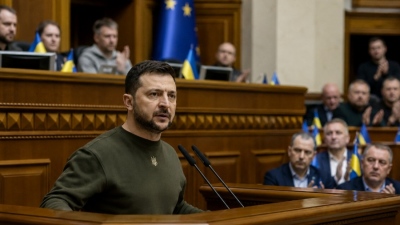
In one of the largest realignments since the beginning of the war, the President of Ukraine, Volodymyr Zelensky, is proceeding with a radical reshaping of the government, provoking new questions regarding the real motives of his decisions and whether the political stability of his country is being tested at a particularly critical period.
Officially, Zelensky argues that a "new political strategy" and a renewal of the cabinet are required.
However, Ukrainian media and political analysts attribute the developments to internal power struggles, personal confrontations, and an effort by the Ukrainian President to consolidate even more control over the state apparatus.
The removal of Yulia Svyrydenko
Zelensky announced the removal of Prime Minister Yulia Svyrydenko, thanking her publicly for her contribution and proposing that she assume a new, "important sector" in Ukraine's relations with a key international partner, without however revealing what this role will be.
She confirmed her departure, stating that she will continue to serve the Ukrainian state from any position assigned to her.
However, according to reports by the Ukrainian media Strana.ua and "Country", her departure might not constitute a simple political upgrade, but part of a broader rearrangement of the power system around Zelensky.

Yulia Svyrydenko
Targeting control of the Ministry of Defense
One of the basic scenarios circulating in Ukraine is that the real target of the government restructuring was not Svyrydenko but the Minister of Defense, Mikhail Fedorov.
According to Ukrainian media, the relations between Zelensky and Fedorov have been in tension for a long time, especially after the public criticism voiced by the Ukrainian President toward the Ministry of Defense regarding the serious problems that have arisen with forced mobilization.
The same report argues that through the resignation of the Prime Minister, the entire cabinet automatically resigns, a fact allowing Zelensky to reshape the government completely and remove ministers with whom he is in conflict.
However, it is pointed out that Fedorov possesses strong political support from organizations funded by European programs, a fact making his potential removal difficult.
Who will be the new prime minister?
The battle of succession has already begun.
According to Ukrainian Member of Parliament Yaroslav Zheleznyak, four persons are considered key candidates:
1) Sergey Koretsky, head of Naftogaz
2) Mikhail Fedorov
3) Denis Shmygal
4) the mayor of Kharkiv, Igor Terekhov
Nonetheless, both the Ukrainian medium "Country" and sources of RBC-Ukraine consider Sergey Koretsky the frontrunner.
In fact, immediately after his meeting with Svyrydenko, Zelensky met first with Koretsky, whom he thanked publicly for his work at the state energy companies Naftogaz and Ukrnafta, an event interpreted as a clear political message.

Shadows around Koretsky
The potential selection of Koretsky does not go unnoticed.
He has occasionally been presented by Ukrainian media as a person connected to Timur Mindić, a close associate of Zelensky who has been at the center of allegations concerning corruption.
Although no charges have been brought against Koretsky, these specific references feed the public debate regarding the balances and influence networks around the Ukrainian presidency.

Sergey Koretsky
New strategy or further concentration of power?
Zelensky argues that the new government will operate under a different model.
As he announced, each key sector of foreign policy will now have a specific person in charge with exclusive competence, particularly in relations with the United States and the European Union.
At the same time, he foreshadowed changes in the leadership of the security forces as well, along with a reinforcement of the state presence in the border regions and on the fronts of the war.
However, several political observers in Ukraine estimate that these moves do not merely reflect an administrative reform, but an effort for further concentration of power around the presidential circle.

Warnings of a severe political crisis
Former Member of Parliament Spiridon Kilinkarov estimated that the restructuring of the government can lead even to a serious political crisis.
From his side, Yaroslav Zheleznyak argued that the decisions were taken hastily and without comprehensive planning, maintaining that they were finalized just a few hours before being announced.
At the same time, according to Strana.ua, the possibility of Svyrydenko moving to the position of the Ambassador of Ukraine to the United States is being examined, while other information links her departure to investigations by the National Anti-Corruption Bureau regarding persons of the close presidential circle.

One more step of power concentration before disaster?
The latest moves by Zelensky reinforce the image of a president attempting to reshape the state apparatus completely in the midst of war.
Officially, the changes are presented as a necessary adaptation to new strategic challenges.
However, the timing, the information regarding internal conflicts, the contradictory leaks about the real motives of the removals, and the public warnings by Ukrainian politicians of a potential political crisis feed the criticism that Zelensky is using the reshuffle not only for the improvement of government functioning, but also to reinforce further his personal control over the executive power.
The shadow of corruption continues to weigh on the Zelensky regime – Alarm in Europe
The government changes take place in a period during which the administration of Volodymyr Zelensky finds itself confronted with increasing pressure over issues of transparency and corruption.
Despite the commitments of the Ukrainian leadership toward the European Union and Western allies for extensive reforms, a series of cases concerning state procurement, defense contracts, public organizations, and high-ranking government officials have been recorded in recent years.
Several ministers, deputy ministers, and regional officials have been removed or have resigned following allegations and investigations for corruption, while the National Anti-Corruption Bureau (NABU) and the Special Anti-Corruption Prosecutor's Office (SAPO) continue to investigate cases concerning persons with significant political influence.
Corruption continues to constitute one of the basic obstacles in the European path of Ukraine.
The European Commission, the G7, and other Western partners have repeatedly stressed that the continuation of economic and military support is linked to the reinforcement of the rule of law, transparency in the management of public resources, and ensuring the independence of the institutions investigating cases of corruption.
Within this environment, the sweeping changes promoted by Zelensky are not interpreted merely as an effort to renew the government scheme.
His critics argue that he is attempting to regain political control in a period where cases of corruption, war fatigue, and difficulties in the economy test the credibility of his government both internally and against Western partners.
www.bankingnews.gr

Σχόλια αναγνωστών